Fertilizer import rules in Türkiye: license, product registration, conformity letter and label
Who must hold the BÜGEM license, what each shipment needs before the customs declaration, and the Turkish label rules a Chinese manufacturer must print.
Short answer: To import chemical fertilizers into Türkiye, your company needs a license and a registration for each product. Each shipment then needs a conformity letter before the customs declaration. Every bag needs the approved Turkish label. The Chinese manufacturer cannot hold these documents for you.
This guide is for a company in Türkiye that plans to import chemical fertilizers from China. It follows the order in which the documents are needed, with the Turkish text and article behind each rule.
The problem is timing. A buyer agrees price and packing with the factory, and the Turkish file starts when the ship is already at sea. Customs will not register the declaration for listed fertilizers without the conformity letter. That letter needs an analysis report less than 6 months old. If the factory's own report is older, laboratory testing coordination can arrange a report on samples from your lot.
Who this is for and what you need
An importer, distributor or producer in Türkiye buying chemical fertilizers from a Chinese manufacturer.
The product specification: grade, nutrient content, form and packing.
A customs broker (gümrük müşaviri) who will confirm the 12-digit GTİP and the lists that apply.
This page covers the fertilizer file. Our guide to the import route from China to Türkiye covers the other stages of the order.
Organic and microbial fertilizers follow a separate regulation (organic, mineral and microbial fertilizers regulation, Resmî Gazete 23 February 2018). Ask your broker which text covers your product before you start.
Why it matters for buyers from China
In 2023, China supplied 585 thousand tonnes of Türkiye's 5.2 million tonnes of fertilizer imports, about 11% (TAGEM policy paper). Argus reported record ammonium sulphate imports of 1.02 million tonnes in the first half of 2025, almost all from China (Argus).
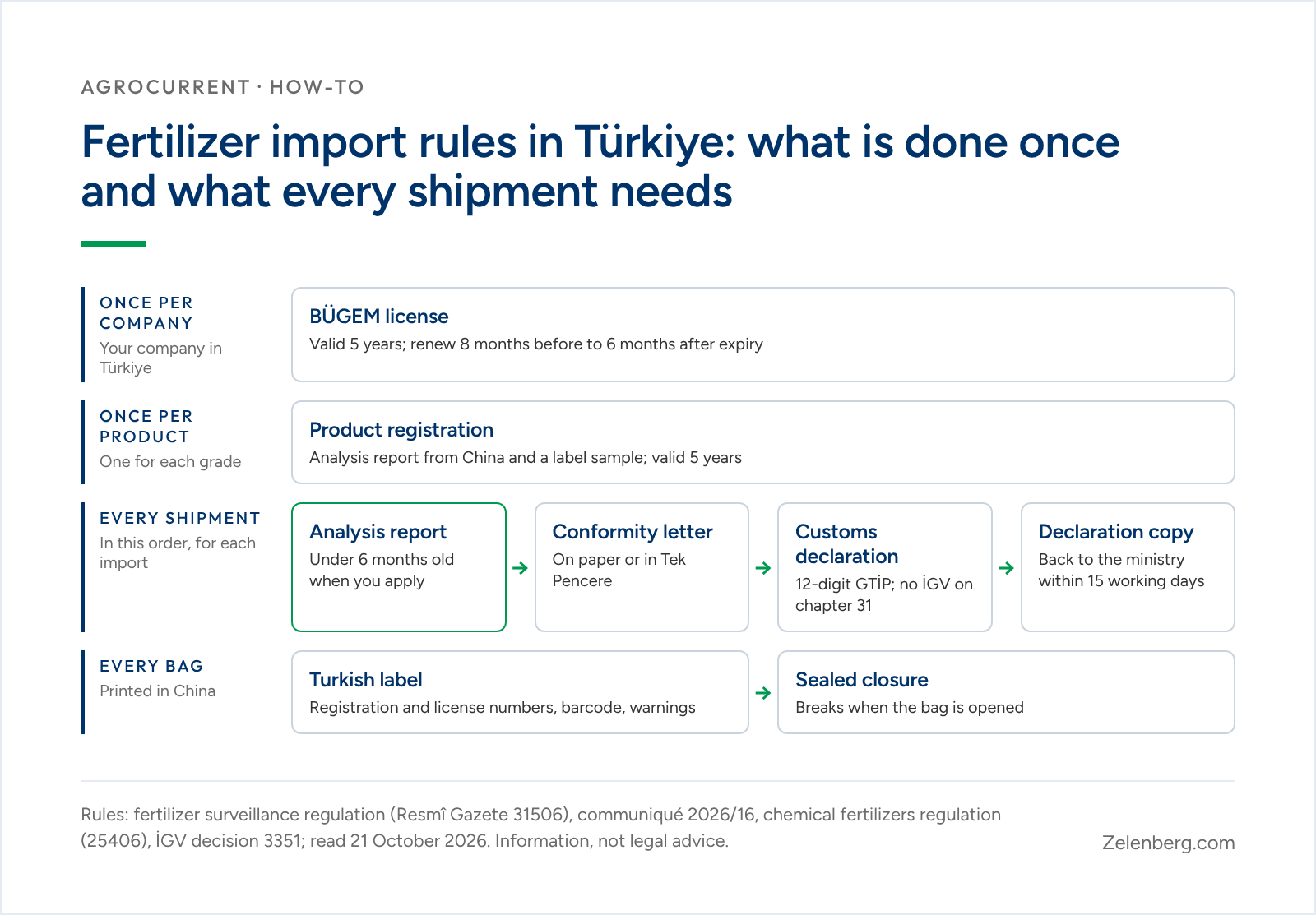
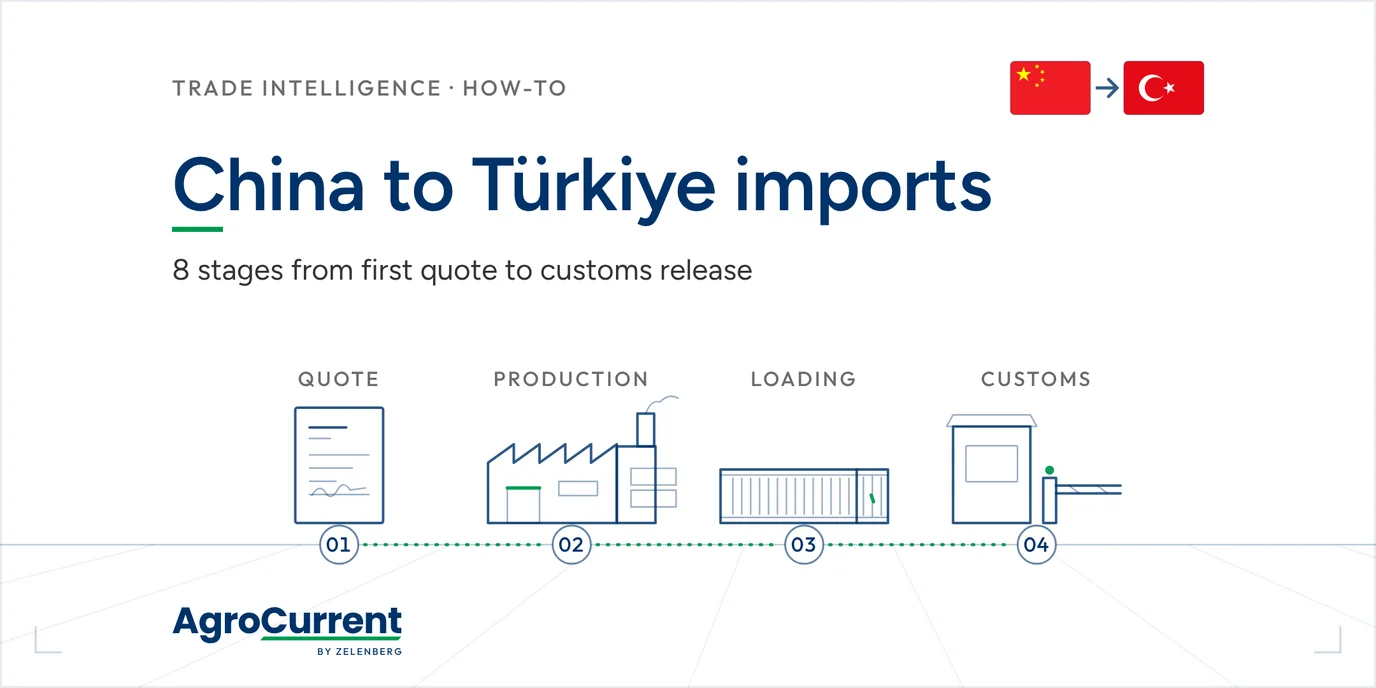
Six steps, from license to customs release
1. Get the company license
Do: apply for a fertilizer license (lisans belgesi) at BÜGEM, the ministry's General Directorate of Plant Production. Use the Annex-8 forms and pay the fee (fertilizer surveillance regulation, Art. 12).
Check: the license lasts 5 years. You can renew it from 8 months before to 6 months after expiry; otherwise it is cancelled. It cannot be transferred or sold (Art. 14).
Evidence to keep: the license number and expiry date, in your order calendar. With a manufacturer abroad, the importer or representative counts as the manufacturer (chemical fertilizers regulation, Art. 4, 6).
2. Register each product
Do: register every product you will sell (tescil belgesi). For an imported product, the file adds an analysis report or certificate from China and a package or label sample (surveillance regulation, Art. 13).
Check: the product name, grade and nutrient values on the registration match what the factory will make. A new grade or a changed formula needs its own registration. Each registration also lasts 5 years (Art. 14).
Evidence to ask the manufacturer for: the analysis report or certificate issued in China, and the label artwork for the package.
3. Agree the Turkish label before production
Do: send the approved Turkish label text to the manufacturer with the purchase contract. Labels, packaging and documents must be in Turkish or carry a Turkish translation (chemical fertilizers regulation, Art. 13).
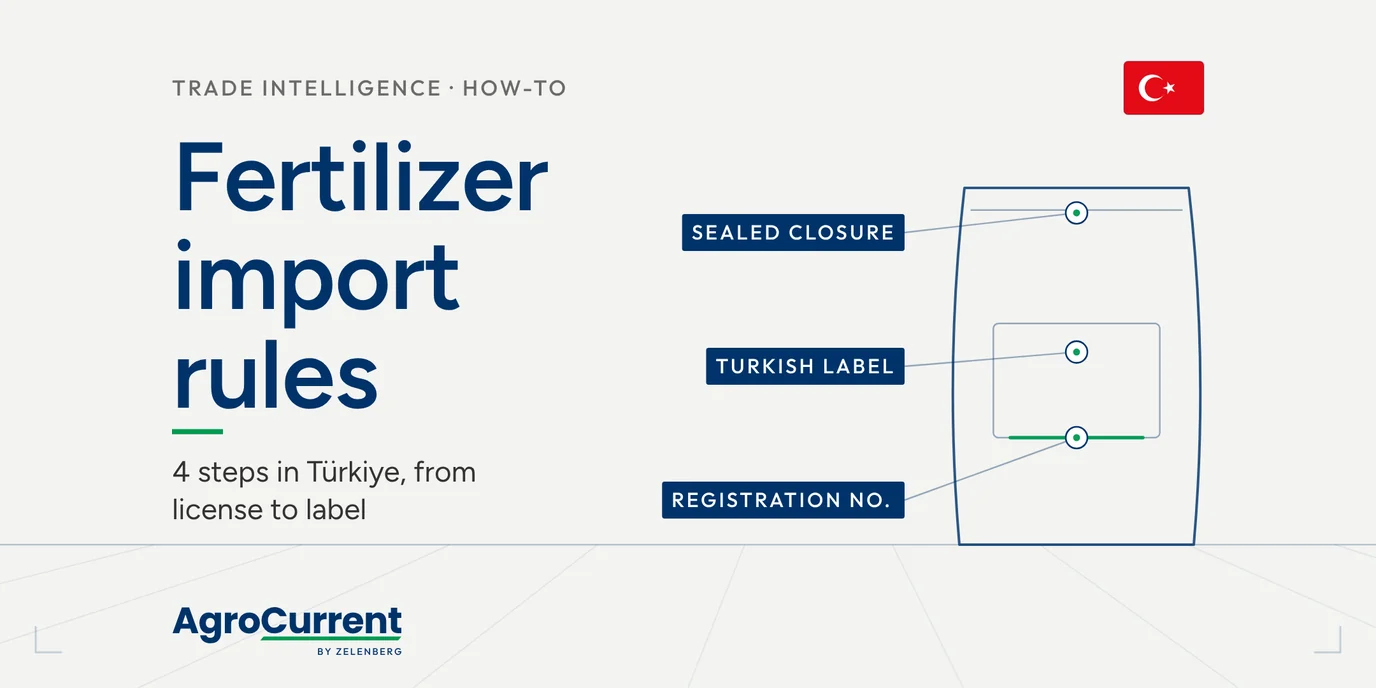
Check: the label shows the fertilizer type, the producer's name and address, and the nutrients in words and chemical symbols (Art. 11). The words "EC Fertilizer" may appear only on a compliant product. A chelated micronutrient says "ile şelatlanmıştır" and names the agent (Art. 8, 11). The closure must break when the bag is opened (Art. 14).
The pack also needs the registration and license numbers and a barcode. It carries the soil or leaf analysis advice and the warning "Çocuklardan Uzak Tutunuz" (surveillance regulation, Art. 24). A pack without them cannot be sold.
Evidence to ask for: dated photos of the first printed bags, before filling starts.
4. Get an analysis report under 6 months old
Do: plan the analysis report for the lot you will ship. The conformity-letter file needs a report less than 6 months old (surveillance regulation, Art. 16).
Check: the report date against the date you will apply, not the date you order. A report from production can expire while the order waits for a vessel. Ask your broker or the directorate which laboratories' reports they accept.
Evidence to ask for: the laboratory's report with its date, the methods and a result for each declared nutrient.
5. Apply for the conformity letter before the customs declaration
Do: apply for the conformity letter (uygunluk yazısı) for each import. The file holds the Annex-7 form, the analysis report, the invoice or proforma and the fee receipt (surveillance regulation, Art. 16).
Check: where the application goes. Ammonium nitrate, calcium ammonium nitrate, potassium nitrate and sodium nitrate go to BÜGEM. All other products go to the provincial directorate (Art. 16).
For goods on the communiqué's two lists, customs will not register the declaration without the letter (fertilizer import communiqué 2026/16, Art. 3). The letter comes on paper or through Tek Pencere, the single window, since 1 January 2026. Ammonium nitrate fertilizer with more than 28% nitrogen also needs a detonation test. The results go in at least 5 days before the goods reach the border (chemical fertilizers regulation, Art. 27, 29).
Evidence to keep: the letter number, ready before the ship arrives.
6. Clear customs and close the file
Do: your broker files the declaration under the 12-digit GTİP, with the conformity letter.
Check: chapter 31 fertilizers are not on the İGV lists, so Chinese fertilizer pays no additional customs duty (İGV decision 3351, 2026 tables). From 3 April 2026, Decision 11147 cut the customs duty to 0% on ammonium sulphate, AN, CAN, DAP and several compound codes. This was reported by KPMG. Confirm the rate for your GTİP with your customs broker.
Evidence to keep: the customs-stamped declaration copy. It goes back to the ministry within 15 working days of the import (communiqué 2026/16, Art. 5).
The documents at a glance
Document | Who holds it | When | Valid for | Where the rule is |
|---|---|---|---|---|
Company license (lisans belgesi) | Your company in Türkiye | Before the first import | 5 years; renew from 8 months before to 6 months after expiry | Surveillance regulation, Art. 12, 14 |
Product registration (tescil belgesi) | Your company, one per product | Before the first import of that product | 5 years | Surveillance regulation, Art. 13, 14 |
Analysis report | From the lot you import | For each conformity letter | Under 6 months old when you apply | Surveillance regulation, Art. 16 |
Conformity letter (uygunluk yazısı) | Your company, per shipment | Before the customs declaration | As stated on the letter | Surveillance regulation, Art. 16; communiqué 2026/16, Art. 3 |
Turkish label | On every pack | Before sale | Must match the approved label | Surveillance regulation, Art. 24; chemical fertilizers regulation, Art. 11, 13 |
Customs declaration copy | Your company | Within 15 working days after import | — | Communiqué 2026/16, Art. 5 |
Rules read from the official texts on 21 October 2026: Resmî Gazete 31506 (2021, amended 2024), 33124 (2025) and 25406 (2004, amended 2015).
Checklist before you sign
Company license valid for the whole order, with the renewal date noted.
Registration in place for each product and grade on the contract.
Approved Turkish label text attached to the contract.
Analysis report planned for the shipped lot, under 6 months old at application.
Conformity letter applied for before the ship arrives.
12-digit GTİP and duty confirmed by your broker.
Declaration copy return date in your calendar.
What goes wrong
The report expires in transit. The factory's report was issued at production, and the shipment waits two months for space. At application the report is too old for the letter.
The factory changes the grade. A new formula ships under the old product name. It has no registration, so it cannot be sold as registered.
The bags are printed in English only. The pack lacks the registration and license numbers and the Turkish warnings. It cannot be sold until it is relabelled.
When to hand the testing to a service
Before: you depend on the factory's own report, taken from a sample you did not see. After: a laboratory you choose tests samples from your lot. Its report reaches your dashboard with a record of how the samples were collected and sealed. Bridge: Zelenberg's team in China collects and seals the samples, and the laboratory issues the results. We do not apply for the license, the registration or the letter; your company or your broker does.
Sources and last checked
Turkish rules: the Resmî Gazete texts linked above, read by article on 21 October 2026. Trade figures: TAGEM (2023) and Argus (2025). This page is information, not legal advice: confirm each rule and the duty for your product with your customs broker.
Questions and answers
Can a Chinese manufacturer hold the fertilizer license in Türkiye?
No. The license and the product registrations are issued to the company that imports in Türkiye, and they cannot be transferred or sold (fertilizer surveillance regulation, Art. 12–14).
How long are the license and the product registration valid?
Five years each. You can renew from 8 months before to 6 months after expiry; after that, the license is cancelled (Art. 14).
Does every fertilizer shipment need a conformity letter?
Yes, for products on the lists of communiqué 2026/16: customs will not register the declaration without it. Industrial, laboratory or trial use, and lots under 50 kg or litres, get a ministry letter instead, without TSE analysis (Art. 16).
Is there additional customs duty (İGV) on fertilizer from China?
No. Chapter 31 is not on the İGV lists (tables of 17 July 2026). The base customs duty depends on the 12-digit GTİP; confirm it with your customs broker.
What must a fertilizer label in Türkiye show?
Turkish text, the fertilizer type, the producer, the nutrients in words and symbols, the registration and license numbers, a barcode and the warning "Çocuklardan Uzak Tutunuz". Chelates name the agent.
Sources
- Resmî Gazete 31506 (via Lexpera), "Tarımda Kullanılan Gübrelerin Piyasa Gözetimi ve Denetimi Yönetmeliği", 2021, amended 2024; read 21 October 2026
- Ministry of Trade, Resmî Gazete 33124 (via Lexpera), "Gübre İthaline İlişkin Tebliğ (İthalat: 2026/16)", 2025, in force 1 January 2026; read 21 October 2026
- Resmî Gazete 25406 (via Lexpera), "Tarımda Kullanılan Kimyevi Gübrelere Dair Yönetmelik", 2004, amended 2015; read 21 October 2026
- Resmî Gazete 30341 (FAOLEX copy), "Organik, Mineral ve Mikrobiyal Kaynaklı Gübreler Hakkında Yönetmelik", 23 February 2018, amended 2024
- Ministry of Trade, "İthalatta İlave Gümrük Vergisi Uygulanmasına İlişkin Karar (3351), text and tables", tables 17 July 2026; read 21 October 2026
- Ministry of Agriculture and Forestry, TAGEM, "Gübre Sektör Politika Belgesi 2023–2027", 2023
- Argus, "Turkish amsul imports cross 1mn t in 1H25", 2025
- KPMG Türkiye, "Azotlu gübre ve diğer bazı gübrelerin gümrük vergisi oranlarında değişiklik", April 2026
AgroCurrent in your inbox
News and analysis on sourcing agricultural inputs. No spam; leave any time.