Full or shared container: FCL vs LCL for a first agri order from China to Türkiye
A side-by-side look at full and shared containers for agri inputs, with the questions to ask your forwarder before you book.
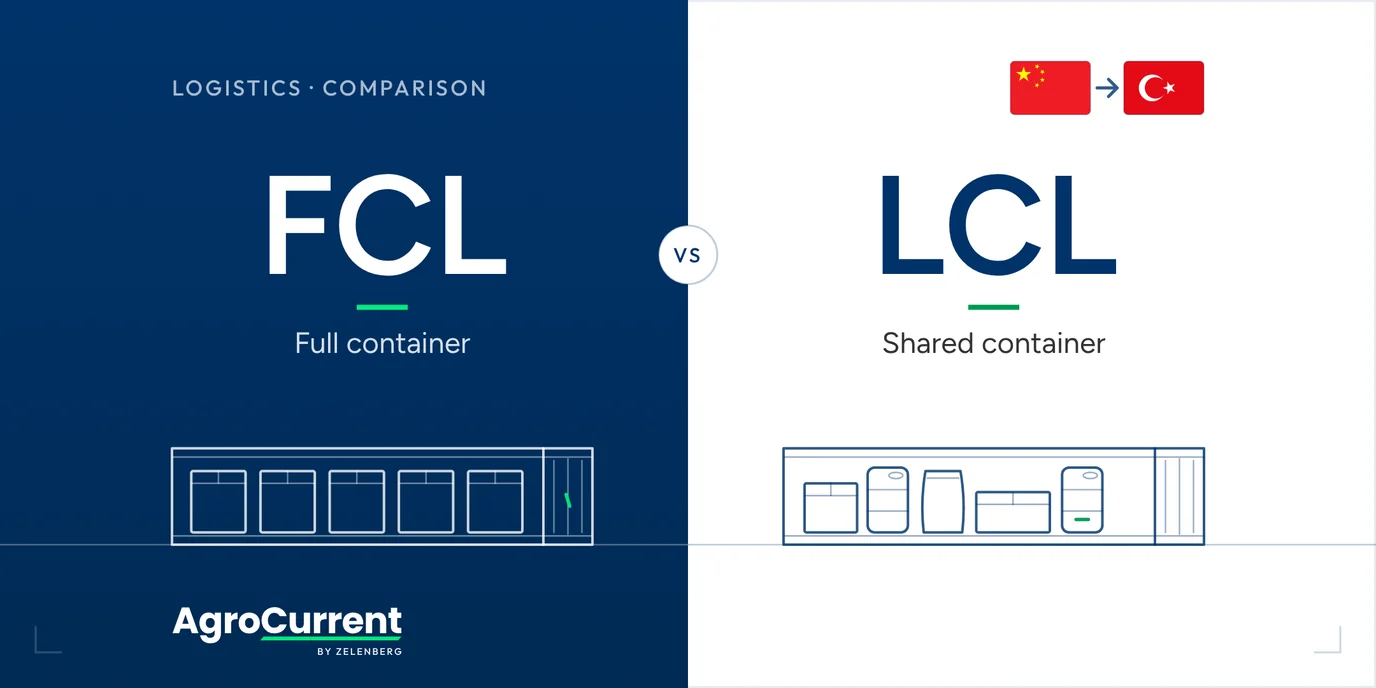
Short verdict: volume, weight and cargo type decide, not a general rule. LCL (less than container load) fits a small lot that is not dangerous goods, such as samples, labels or spare parts. FCL (full container load) fits bagged fertilizer, drums and machines, which fill a box quickly and travel better sealed. One forwarder puts the point where LCL costs about as much as a 20ft container at 13 to 15 cubic meters.
Disclosure: Zelenberg offers AgroAgent, our China sourcing agent service, which follows one order to the shipping documents with either container type. We name no forwarder and quote no freight rate here.
FCL vs LCL at a glance
Criterion | FCL (full container) | LCL (shared container) | Source |
|---|---|---|---|
What you pay for | The whole container, at one rate per box | The space your cargo uses: per cubic meter or per tonne, whichever is higher | SEKO Logistics, 2026 |
Minimum | One container | Usually 1 cubic meter | SEKO Logistics, 2026 |
Where it is packed | At the factory | At the consolidator's warehouse (container freight station, CFS) | SEKO Logistics, 2026 |
Handling | Sealed from origin; opened at destination | Several handling points at warehouses in China and Türkiye | SEKO Logistics, 2026 |
Transit | Port to port | Port to port plus warehouse days at both ends | SEKO Logistics, 2026 |
Bill of lading | One bill of lading for the box | A house bill of lading for each shipper in the box | SEKO Logistics, 2026 |
Weight limit | The box payload: 28,130 kg in one carrier's 20ft | The consolidator's limits per shipment | Hapag-Lloyd, read 4 Nov 2026 |
Dangerous goods | IMDG Code applies | IMDG Code applies, and the consolidator decides which classes it takes | IMO; SEKO Logistics, 2026 |
Loading record at the factory | Possible: empty container to sealed doors | Not possible: the shared box is packed at the warehouse | Zelenberg service scope |
Sources: SEKO Logistics, LCL shipping guide, 30 July 2026; Hapag-Lloyd 20ft specification, read 4 November 2026; IMO, IMDG Code page.
How we compared
We used five questions a first-time importer asks. How much will it cost? How safe is the cargo? How long will it take? What paperwork changes? What can be checked in China? We did not use freight rates, because they change every week. Ask for both quotes on the same day.
Cost: how each bill is built
FCL is one rate for the box, plus port and document charges. LCL is billed per revenue tonne (RT): one cubic meter or 1,000 kg, whichever gives the higher figure (SEKO Logistics). Most consolidators charge at least 1 cubic meter.
Shipment (illustrative) | Volume | Weight | Billed as | What decides |
|---|---|---|---|---|
Two pallets of empty bottles | 4.3 m³ | 500 kg | 4.3 RT | Volume |
100 bags of fertilizer, 50 kg each | About 4 m³ | 5,000 kg | 5 RT | Weight |
Spare parts in 3 cartons | 0.4 m³ | 120 kg | 1 RT | Minimum |
Illustrative shipments; volumes and weights are rounded. Our calculation with the revenue-tonne rule.
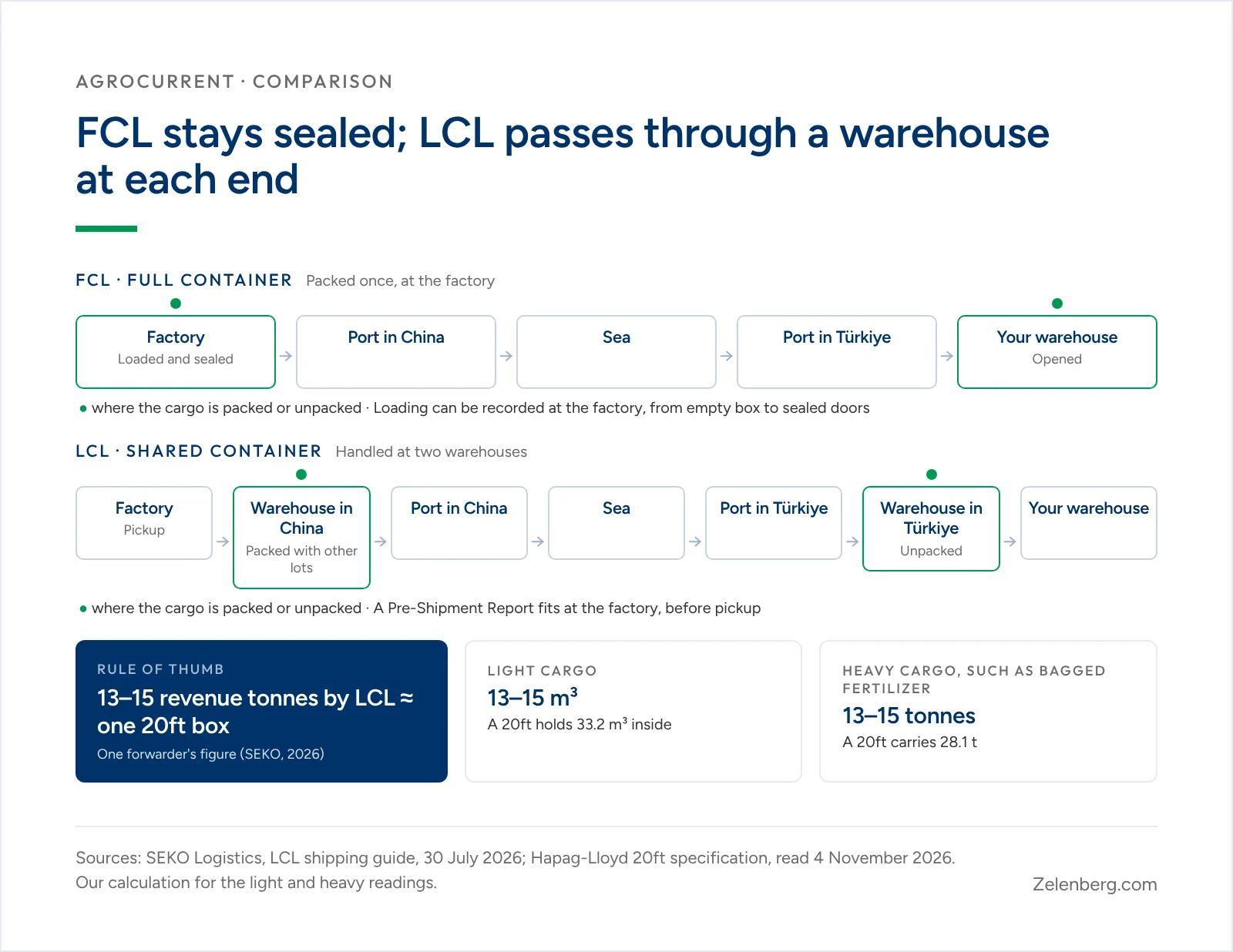
The 13 to 15 cubic meter rule of thumb is about revenue tonnes, so it works for weight too. Light cargo reaches it at 13 to 15 m³, less than half of the 33.2 m³ inside a 20ft box (Hapag-Lloyd). Heavy cargo, billed by weight, reaches it at 13 to 15 tonnes, about half of a 20ft payload. For bagged fertilizer, count tonnes, not cubic meters.
LCL also adds warehouse charges at both ends. Ask for an all-in quote from the factory gate to your port in Türkiye, for both options, on the same day.
Risk: how often the cargo is handled
An FCL box is loaded at the factory and opened at destination. LCL cargo is unloaded at a warehouse in China, packed with other shippers' goods, and unpacked again at a warehouse in Türkiye. Each move is a chance for torn bags, crushed cartons or a leaking drum. Strong packing and clear shipping marks matter more in LCL, because your lot must be found among others.
Dangerous goods
Some pesticides and fertilizers are classed as dangerous goods for sea transport; the safety data sheet says whether yours is. At sea, the IMDG Code covers their packing, container traffic, stowage and the segregation of incompatible substances. It has been mandatory under SOLAS since 1 January 2004 (IMO).
In a shared box, your drums sit next to other shippers' cargo, so each consolidator sets the classes it accepts. One forwarder's Asia to southern Europe service takes all IMO classes except 1 and 7 (SEKO Logistics). Another service may take fewer. Send the safety data sheet before you book, and ask for the answer in writing.
Time
FCL goes port to port. LCL adds the days the consolidator needs to fill the container in China and to unpack it at destination. For a seasonal product, those days can matter more than the freight saving.
They also matter for Turkish documents. A pesticide needs more than 6 months of shelf life left for the conformity letter (pesticide import regulation, Art. 8). A fertilizer letter needs an analysis report under 6 months old; see our guide to fertilizer import rules.
Paperwork for Türkiye
The Turkish import rules do not depend on the container type. The same license, registration and conformity letter apply. The bill of lading changes. FCL travels on one bill of lading for the box. LCL travels on a house bill of lading that the consolidator issues for each shipper (SEKO Logistics). Check who is named as shipper and consignee before you pay the balance. Confirm the documents for your product with your forwarder and customs broker.
What can be checked in China
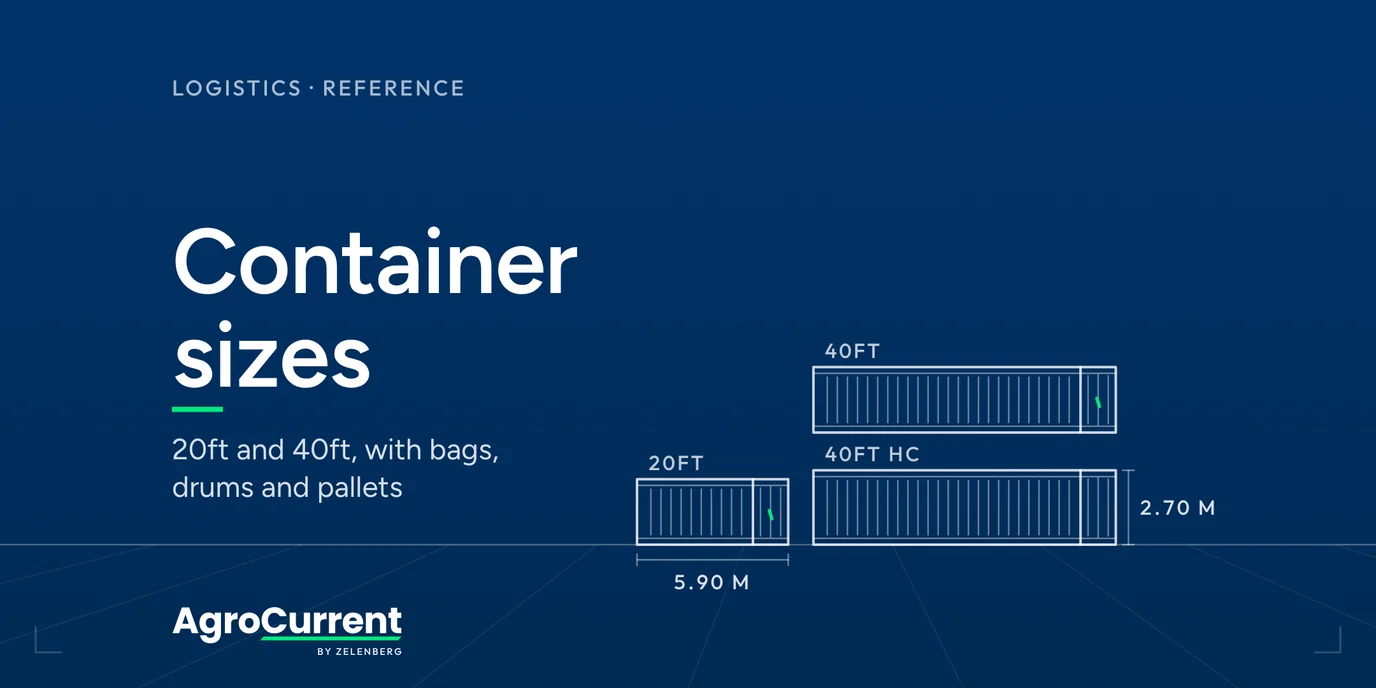
With FCL, the box is loaded at the factory, so the loading can be recorded from the empty container to the sealed doors. Our Container Loading Report does this, with quantities and container and seal numbers. Plan the load with our page on shipping container dimensions.
With LCL, the shared box is packed later, at the consolidator's warehouse. Our Container Loading Report does not cover LCL cargo. The record that fits is a Pre-Shipment Report at the factory before pickup: photos and video of the goods and their storage. It is a visual report, not an inspection.
Option by option
FCL
Feature: you rent the whole box. Advantage: it is loaded and sealed at the factory, and nobody else's cargo shares it. Benefit: fewer touches for heavy bags and drums, one bill of lading, and a record of what went in.
LCL
Feature: you pay for the space you use. Advantage: a small order does not pay for an empty box. Benefit: you can test a product or a manufacturer with less money tied up in freight.
Which fits which buyer
- Samples, labels or spare parts: LCL. The volume is small, and the goods are not dangerous.
- A first pallet or two of packaging, such as bags or bottles: LCL under about 13 m³. Above that, compare an FCL quote.
- Bagged fertilizer, drums of pesticides or a machine: FCL in most cases. Weight reaches the break-even fast, dangerous goods limit LCL, and loading at the factory can be recorded.
Questions to ask your forwarder
- What is the all-in cost for FCL and for LCL, from the factory to your port in Türkiye, on the same date?
- For LCL, what is the warehouse cut-off in China, and how many days to unpack in Türkiye?
- Do you accept this product in LCL? Here is the safety data sheet.
- Which bill of lading will I receive, and who is named as shipper and consignee?
What we could not confirm
- Current FCL and LCL rates from Chinese ports to Türkiye; they change every week.
- Each consolidator's dangerous-goods rules and transit days on this route.
More guides on Containers. Sources: SEKO Logistics (30 July 2026), Hapag-Lloyd (read 4 November 2026), IMO and the Turkish pesticide import regulation (read 21 October 2026).
Questions and answers
When does FCL become cheaper than LCL?
There is no fixed point, because rates change by route and month. One forwarder puts it at 13 to 15 cubic meters (or revenue tonnes), where LCL approaches the cost of a 20ft container. Ask for both quotes on the same day.
Can fertilizer or pesticides go by LCL?
Sometimes. Some pesticides and fertilizers are dangerous goods under the IMDG Code, and each consolidator decides which classes it accepts in a shared box. Send the safety data sheet before you book.
Is a container loading report possible for LCL?
No. Our Container Loading Report records a container loaded at the factory, from the empty container to the sealed doors. LCL cargo is packed at the consolidator's warehouse, so a pre-shipment report before pickup is the record that fits.
Sources
- SEKO Logistics, "LCL Shipping: Strategic Ocean Freight Consolidation for Today's Agile Supply Chains", 30 July 2026
- Hapag-Lloyd, "20' Standard container specification", read 4 November 2026
- International Maritime Organization (IMO), "The International Maritime Dangerous Goods (IMDG) Code", read 7 November 2026
- Resmî Gazete 30625 (FAOLEX copy), "Bitki Koruma Ürünleri ile Bitki Koruma Ürünü Hammaddelerinin İthalatı Hakkında Yönetmelik", 2018; read 21 October 2026
AgroCurrent in your inbox
News and analysis on sourcing agricultural inputs. No spam; leave any time.