20ft and 40ft container sizes for bagged fertilizer, drums and machines
One table with inside dimensions, door openings and payload, plus how many pallets and bags fit and how to check drums and machines.
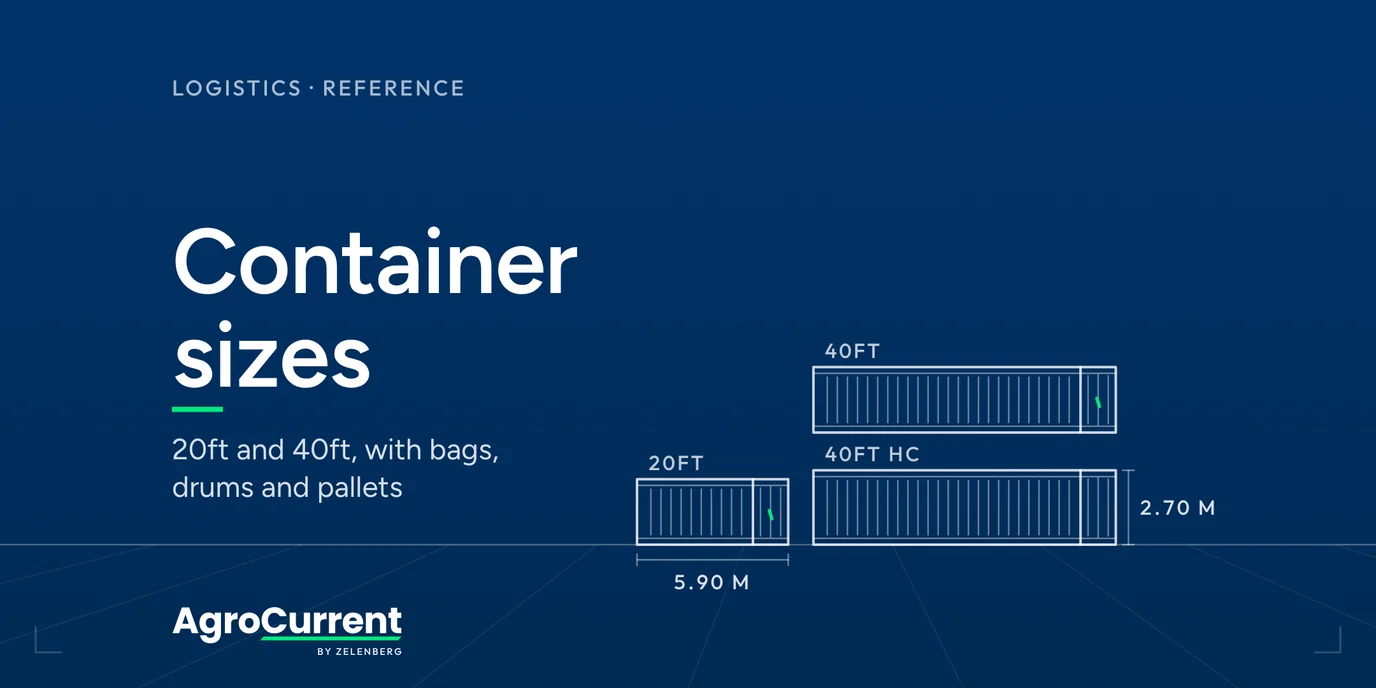
Short answer: A 20ft container is 5.90 m long inside, and a 40ft is 12.03 m. Both are about 2.35 m wide and 2.39 m high inside. A 40ft high cube adds 30 cm of height. All three carry about the same weight, 28.1 to 28.8 tonnes.
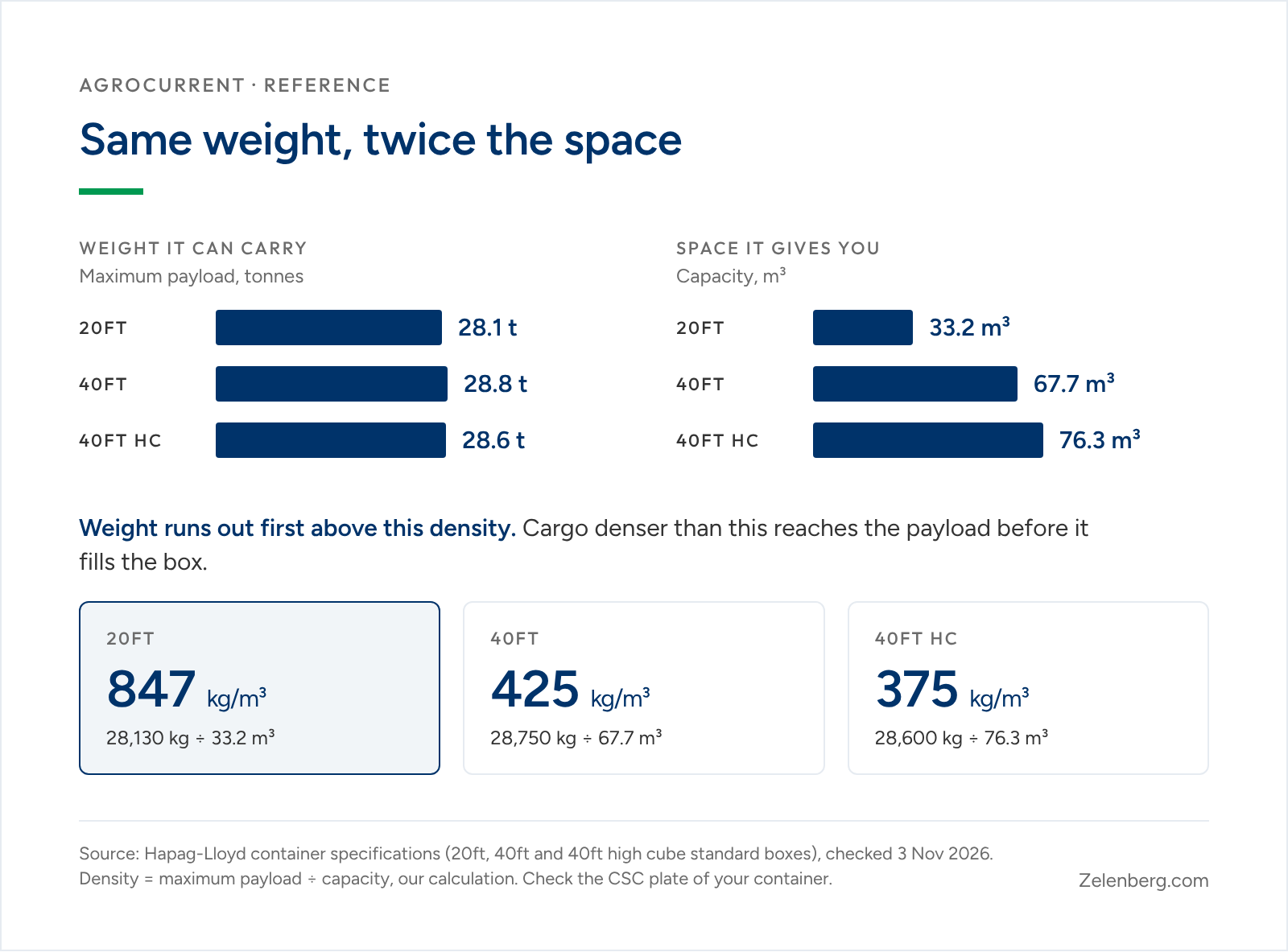
So a 40ft gives you twice the space, but almost no extra weight. Dense cargo, such as many bagged fertilizers and full drums, can reach a 20ft's weight limit before it fills the space. Machines, cartons and empty packaging use the space of a 40ft or a high cube. Our container loading report records the box you get, from the empty container to the sealed doors.
Container dimensions: 20ft, 40ft and 40ft high cube
Measure | 20ft standard | 40ft standard | 40ft high cube |
|---|---|---|---|
Inside length | 5,900 mm | 12,032 mm | 12,032 mm |
Inside width | 2,352 mm | 2,352 mm | 2,350 mm |
Inside height | 2,395 mm | 2,395 mm | 2,700 mm |
Door opening (width × height) | 2,340 × 2,292 mm | 2,340 × 2,292 mm | 2,340 × 2,597 mm |
Capacity | 33.2 m³ | 67.7 m³ | 76.3 m³ |
Tare weight (empty box) | 2,350 kg | 3,750 kg | 3,900 kg |
Maximum payload | 28,130 kg | 28,750 kg | 28,600 kg |
Maximum gross weight | 30,480 kg | 32,500 kg | 32,500 kg |
Source: Hapag-Lloyd container specifications for the 20ft standard, 40ft standard and 40ft high cube. Last checked 4 November 2026.
What fits, worked out from the figures above
Our calculation | 20ft standard | 40ft standard | 40ft high cube |
|---|---|---|---|
Pallets 1,200 × 800 mm on the floor, one layer | 11 | 25 | 25 |
Pallets 1,200 × 1,000 mm on the floor, one layer | 9 | 22 | 22 |
50 kg bags at full payload | 562 | 575 | 572 |
Average weight per 1,200 × 800 mm pallet at full payload | 2,557 kg | 1,150 kg | 1,144 kg |
Cargo density at which weight and space run out together | 847 kg/m³ | 425 kg/m³ | 375 kg/m³ |
Pallet counts use the best floor pattern for the inside length and width. Bag counts are payload ÷ 50 kg and ignore the weight of pallets and dunnage. Density is maximum payload ÷ capacity.
How to read the table
- Use the inside figures. "20ft" and "40ft" name the outside length. Your cargo has to fit the inside length, width and height.
- The door decides for machines. The door is lower than the inside: 2.29 m on a standard box and 2.60 m on a high cube. A crate taller than the door does not go in, even if the inside height allows it.
- Payload decides for heavy cargo. If your cargo is denser than 847 kg/m³, a 20ft reaches its weight limit before it is full. In a 40ft, that point is 425 kg/m³.
- The box itself is final. Hapag-Lloyd says its figures are only an example, because containers vary by manufacturer. Each box shows its own tare and maximum gross weight on its CSC safety plate.
- Roads can set a lower limit. A truck to or from the port may not carry a full payload. Ask your forwarder for the road limit in China and in Türkiye before you plan the load.
Worked example: bags, drums and machines
Bagged fertilizer
A 20ft can take up to 562 bags of 50 kg by payload (28,130 kg ÷ 50 kg). A 40ft takes 575 bags, only 13 more. For heavy bags, a 40ft adds space that you cannot fill. Ask the manufacturer for the gross weight per bag and the planned count, then check the total against the payload.
Empty bags and cartons are the opposite case. They are light and bulky, so a 40ft or a high cube carries more of them for each container.
Drums on pallets
When drums travel on pallets, the floor sets the space limit: 11 pallets of 1,200 × 800 mm in a 20ft and 25 in a 40ft. Then check the weight. In a 40ft, 25 pallets can average no more than 1,150 kg each, pallet included. Multiply drums per pallet by the filled weight of one drum to see if you are under that figure.
This applies to steel drums and to plastic drums and bottles. Wooden pallets also need the ISPM 15 mark for heat treatment.
Machines
For a tractor, a seeder or a filling machine, start with the crated height. Compare it with the door: 2,292 mm on a standard box and 2,597 mm on a high cube. Leave space for the forklift to set the crate down. If the crate is taller than a high-cube door, ask your forwarder about open-top or flat-rack containers.
If one machine does not fill a box, compare a full container with a shared one before you book. Once the box is loaded, its container number and seal number go on the bill of lading.
Source and last checked
Container figures: Hapag-Lloyd specification pages, last checked 4 November 2026. Pallet sizes: 1,200 × 800 mm and 1,200 × 1,000 mm, two of the flat pallet sizes in ISO 6780. Pallet, bag and density figures are our own calculation from these specifications. More guides on Containers.
Questions and answers
How many pallets fit in a 40ft container?
On the floor in one layer: 25 pallets of 1,200 × 800 mm or 22 of 1,200 × 1,000 mm, worked out from Hapag-Lloyd's inside dimensions. Whether you can stack them depends on the inside height, the door and the payload.
What is the difference between a 40ft and a 40ft high cube?
The floor is the same. A high cube is 2,700 mm high inside instead of 2,395 mm, and its door is 2,597 mm high instead of 2,292 mm. The payload is about the same: 28,600 kg against 28,750 kg on Hapag-Lloyd's specifications.
How much weight can a 20ft container carry?
28,130 kg of cargo on Hapag-Lloyd's specification, with a maximum gross weight of 30,480 kg. Each box shows its own figures on its CSC plate, and road limits in China or Türkiye can be lower. Ask your forwarder.
Sources
- Hapag-Lloyd, "20' Standard container specification", read 4 November 2026
- Hapag-Lloyd, "40' Standard container specification", read 4 November 2026
- Hapag-Lloyd, "40' Standard High Cube container specification", read 4 November 2026
- ISO, "ISO 6780:2003 Flat pallets for intercontinental materials handling — Principal dimensions and tolerances", 2003
AgroCurrent in your inbox
News and analysis on sourcing agricultural inputs. No spam; leave any time.